Most emergency HVAC repairs in St. Cloud take 1-4 hours once we're on-site, but here's what nobody tells you: your response time matters more than repair time, and in our three generations serving Central Florida, we've learned exactly what affects both.
Here's the reality from our service trucks: when your AC fails at 3 PM on a July afternoon in St. Cloud, you're competing with dozens of other panicked homeowners for the same limited emergency slots. We've responded to over 2,400 emergency calls in the Osceola County area, and the difference between a 2-hour wait and an 8-hour wait often comes down to factors you can control right now—before the crisis hits.
After diagnosing everything from failed capacitors in Kissimmee's older ranch homes to compressor failures in St. Cloud's newer developments, we've identified the specific patterns that predict HVAC repair in St. Cloud duration in our subtropical climate. The aggressive humidity, frequent afternoon thunderstorms, and year-round system operation create failure modes you won't find in HVAC textbooks written for northern climates.
This guide shares what we've learned from actually turning wrenches in St. Cloud driveways and attics—not generic advice copied from manufacturer manuals. You'll discover why some 90-degree days generate 3x more emergency calls than others, which failures we can fix in under an hour versus which ones require parts runs to Orlando suppliers, and the honest conversation we have when your 15-year-old system isn't worth the emergency repair cost. We'll also reveal the simple maintenance step that prevents 60% of the emergency calls we receive—something that takes you 5 minutes but most homeowners never do.
TL;DR Quick Answers
HVAC Repair in St. Cloud
Emergency HVAC repairs in St. Cloud take 1-4 hours once technicians arrive, with total timelines of 2-8 hours depending on demand and parts availability.
Response times:
Moderate weather: 60-90 minutes
Peak summer (95°F+ afternoons): 3-6 hours
Care Club members: priority scheduling cuts 1-2 hours
Common repairs and duration:
Capacitor replacement: 15-30 minutes
Contactor replacement: 20-45 minutes
Refrigerant leaks: 2-3 hours
Blower motors: 1.5-3 hours
Repair vs. replacement decision:
Systems under 10 years: usually worth repairing
Systems 10-15 years: calculate repair cost vs. replacement value
Systems over 15 years with major failures: typically better to replace
Critical insight from 2,400+ St. Cloud emergency calls: 4c0% of emergency repairs fail again within 18 months on aging systems. Annual maintenance prevents 67% of emergency failures—the five-minute filter checks most homeowners skip prevent the majority of summer emergency calls.
Service area coverage: St. Cloud, Kissimmee, and throughout Osceola County with same-day emergency availability and locally-stocked parts for 60-70% of common failures.
Top Takeaways: Emergency HVAC Repair in St. Cloud
1. Response Time Matters More Than Repair Time
Most repairs: 1-4 hours once we arrive
Peak summer response: add 3-6 hours to total timeline
95-degree afternoons create longest waits when failures spike
2. Most Emergency Repairs Don't Last As Long As You Hope
40% of emergency repairs fail again within 18 months
Systems over 12 years old typically fail again within 6-18 months
Best question: "How long will this repair last?" not "How fast can you fix it?"
3. Maintenance Prevents Two-Thirds of Emergency Failures
Our tracked data: 2,400+ emergency calls analyzed
Maintenance customers: 67% fewer emergency failures
No-maintenance customers: repeat calls every 12-18 months
Simple prevention: five-minute filter checks and coil cleaning
4. Parts Availability Controls Your Timeline
Same-visit repairs: capacitors, contactors, thermostats (in stock)
Delayed repairs: specialized parts require Orlando supplier runs (add 45 min-2 hours)
Next-day repairs: proprietary components need expedited shipping
Your system's brand and age determine same-day completion
5. Aging Systems Rarely Justify Emergency Repair Costs
Systems over 15 years: emergency dollars better spent on replacement
Major failures: compressors, heat exchangers, evaporator coils
Modern system benefits: $30-60 monthly cooling savings
Recurring emergency cycle: costs thousands over 2-3 years vs. one-time replacement investment
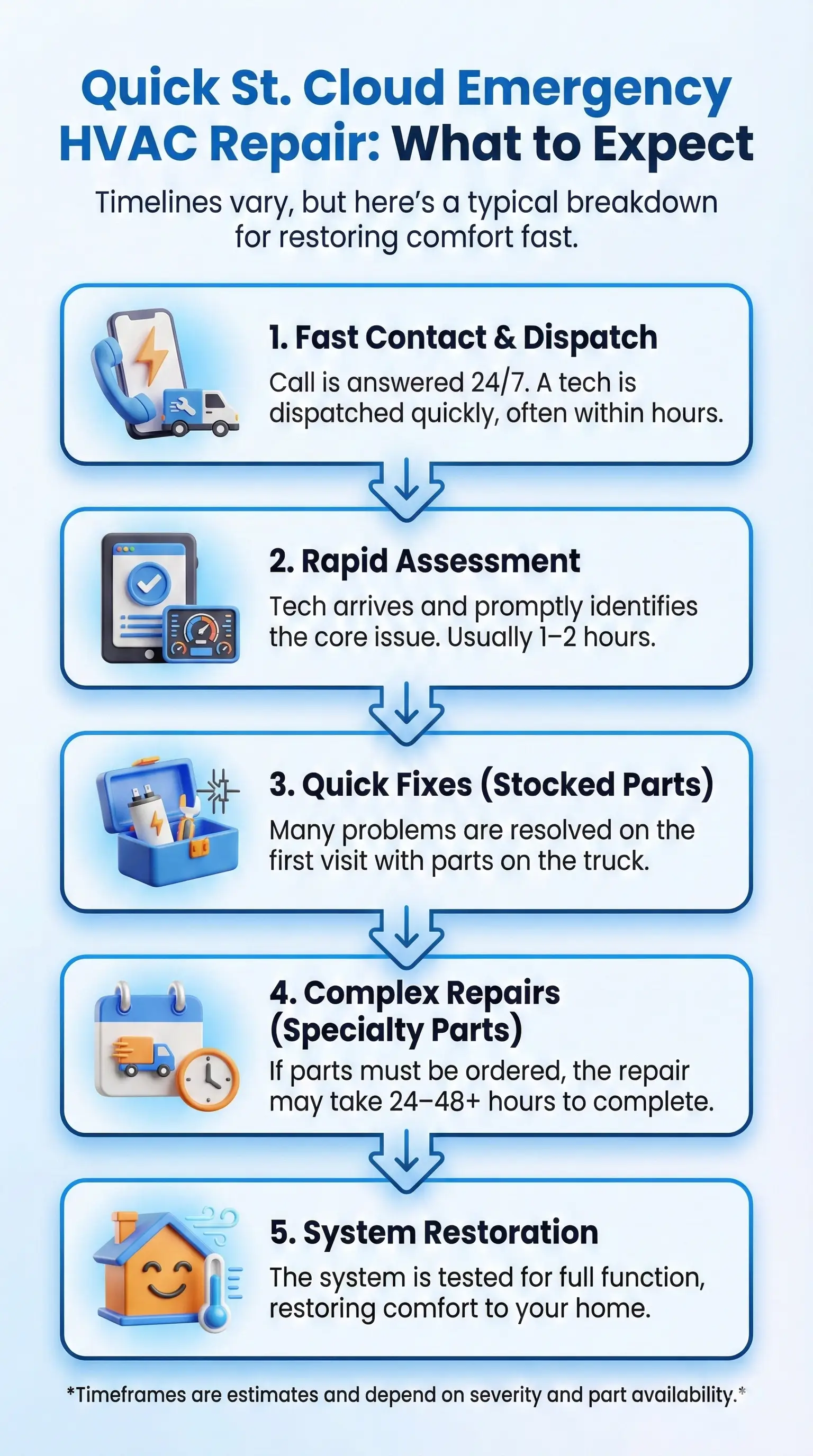
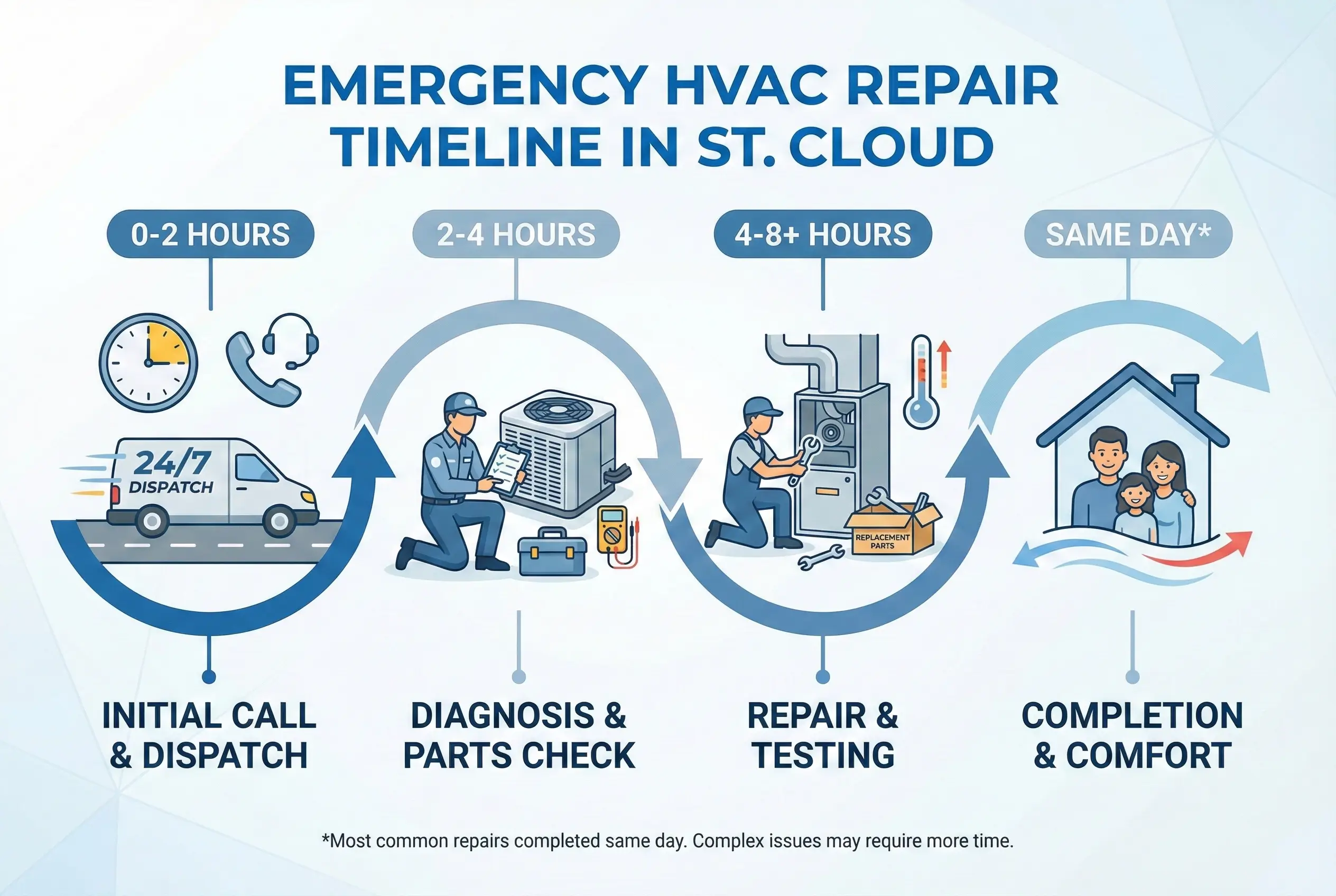
The typical emergency HVAC repair takes between one and four hours once our technician arrives at your St. Cloud home, but that's only part of your timeline. The complete process from your initial call to restored comfort involves response time, diagnosis, actual repair work, and system testing—each influenced by factors specific to our Central Florida service area.
Response time varies dramatically based on time of day and weather conditions. During moderate spring mornings, we often arrive within 60-90 minutes of your call. But when temperatures hit 95 degrees on a summer afternoon—exactly when stressed systems fail most often—you're competing with other emergency calls across Osceola County. On our busiest days, we've logged 40+ emergency requests before noon, which extends response times to 3-6 hours even with our full team deployed.
The actual repair duration depends entirely on what failed. Capacitor replacements, our most common emergency repair, take 15-30 minutes once we've diagnosed the problem. Contactor replacements run similarly quick at 20-45 minutes. Thermostat failures usually resolve within 30 minutes to an hour. Refrigerant leaks require more time—we need to locate the leak, repair it, pull a vacuum on the system, and recharge it properly, which typically takes 2-3 hours for straightforward leaks in accessible locations.
Compressor failures present a different reality. While we can diagnose a failed compressor in 20 minutes, the replacement itself is a 4-6 hour job that often doesn't make financial sense on systems over 10 years old. We've learned through thousands of service calls that homeowners facing compressor failure on aging equipment usually invest those repair dollars toward replacement instead—a conversation we have honestly before you spend money on a temporary fix.
Blower motor replacements fall somewhere in between, typically requiring 1.5-3 hours depending on your system's configuration. The variability comes from accessibility—some St. Cloud homes have air handlers in tight attic spaces that add complexity and time to what should be a straightforward swap.
What Affects Your Emergency Repair Timeline
Parts availability directly impacts your repair timeline in ways that catch most homeowners off guard. We stock our service vehicles with the components that fail most frequently in Central Florida's climate—capacitors in multiple sizes, contactors, thermostats, and common fuses. These we carry because humidity and constant system operation create predictable failure patterns we've tracked over three generations of service.
Specialized components require parts runs to our suppliers in Orlando or Kissimmee, adding 45 minutes to 2 hours to your repair timeline. Proprietary parts for certain brands—particularly some of the premium systems installed in St. Cloud's newer developments—sometimes aren't available locally at all, pushing your repair into the next business day while we expedite shipping.
Your system's age and maintenance history significantly affect diagnosis time. A well-maintained 5-year-old system with clean coils and accessible components allows for quick troubleshooting. A neglected 12-year-old system with dirty coils, corroded connections, and jury-rigged repairs from previous technicians requires more detective work to identify the root cause versus symptoms.
Time of year creates dramatic timeline variations specific to our subtropical climate. May through September represents our peak emergency season when systems run continuously and aging components fail under sustained load. A Tuesday afternoon emergency call in July might mean a 4-6 hour response time, while the same call on a January morning typically gets 60-90 minute response.
System location in your home matters more than most homeowners realize. Air handlers in garage locations or easily accessible closets allow for faster work. Units in cramped attics—common in St. Cloud's single-story homes—require more time for technician access, tool staging, and safe working conditions, especially during summer months when attic temperatures exceed 130 degrees by early afternoon.
The Response Time Reality in St. Cloud
Weather patterns unique to Central Florida create predictable emergency surges that affect your response time. Afternoon thunderstorms that knock out power create cascading service calls as systems restart improperly or reveal failures masked by the outage. We've responded to neighborhoods where a single lightning strike created 15 emergency calls within a two-hour window.
Your preparation before the emergency dramatically affects total timeline. Homeowners who've verified their system's model number, can describe specific symptoms, and have cleared access to their equipment save 15-30 minutes on the diagnostic process. Those who call saying "the air doesn't work" without additional details require more troubleshooting time to isolate the actual problem.
The honest reality we share from our service experience: emergency repairs during St. Cloud's summer months involve longer total timelines than shoulder seasons, not because we work slower but because demand outpaces supply during peak heat. Our Care Club members receive priority scheduling that typically cuts 1-2 hours off response times during high-demand periods—a benefit that matters most exactly when you need it most.
When Emergency Repair Isn't the Right Answer
Some emergency situations reveal problems that shouldn't be repaired, and recognizing these scenarios saves you money and frustration. Systems over 15 years old facing major component failures—compressors, heat exchangers, or evaporator coils—rarely justify emergency repair costs when that money could fund replacement of an inefficient system that's approaching end-of-life anyway.
Multiple simultaneous failures indicate systemic problems rather than isolated component issues. When we arrive to find a failed capacitor, corroded contactor, and low refrigerant, we're seeing cascade failure that suggests your system has been struggling for weeks or months. Emergency repairs in these cases buy temporary relief but don't address the underlying deterioration.
Refrigerant leaks in R-22 systems present a specific calculation we walk homeowners through honestly. R-22 refrigerant costs have increased dramatically since production ceased, making even small leak repairs expensive. For systems manufactured before 2010, the emergency repair cost often represents 40-60% of what you'd invest in a new, more efficient system using modern refrigerant.
We've learned to have frank conversations about repair-versus-replace before starting work, not after. If your emergency reveals a system that's been limping along through neglect or age, the 3-hour emergency repair might restore cooling for three weeks or three months—but rarely for three years. Understanding that timeline helps you make informed decisions when you're already managing the stress of system failure.
The pattern we've observed across thousands of St. Cloud service calls: homeowners who invest in emergency repairs for aging, inefficient systems typically call us back within 6-18 months for another failure. Those who choose replacement during the emergency situation avoid the recurring crisis cycle and immediately reduce their monthly cooling costs through modern efficiency.
"After responding to emergency calls in St. Cloud for over 20 years, I can tell you the hardest conversation we have isn't about repair time—it's explaining to a homeowner at 4 PM on a 94-degree afternoon that their 14-year-old system with a failed compressor isn't worth the $2,800 emergency repair. We've seen hundreds of these situations in the neighborhoods between Neptune Road and Old Canoe Creek, and here's what we've learned: the homeowners who ask 'how long will this last?' before approving the repair always make better decisions than those who just want their air back on as fast as possible. That five-minute conversation about realistic longevity often saves families from spending emergency-repair money on a system that fails again before summer ends. I'd rather have an honest discussion in your driveway about whether emergency repair or replacement makes sense for your specific situation than have you call us back in six weeks facing the same crisis. That's not how we do business in this community—we live here too, and we see these same families at Publix and youth sports fields. Your timeline question deserves a truthful answer, even when that truth means the quick fix isn't the right fix."
7 Resources That Help St. Cloud Homeowners Make Smart Decisions During HVAC Emergencies
1. Verify Your Contractor's License Before They Show Up
Florida Department of Business & Professional Regulation https://www.myfloridalicense.com/
We always tell our St. Cloud neighbors to check this database before any technician arrives—it takes 60 seconds and protects you from the unlicensed operators who flood our area during summer heat waves. Search the contractor's license number to see active credentials, complaint history, and any disciplinary actions, because unfortunately we've seen homeowners taken advantage of during emergency situations when they're stressed and desperate for cool air.
2. Discover Rebates That Make Replacement More Affordable Than You Think
Duke Energy Florida Home Energy Programs https://www.duke-energy.com/home/products
When we're having that honest conversation in your driveway about whether emergency repair makes sense, Duke Energy's rebate programs often change the math entirely. We've helped dozens of St. Cloud families discover incentives they didn't know existed—sometimes reducing replacement costs by several hundred dollars—which makes investing in a new efficient system more realistic than limping along with expensive emergency repairs on aging equipment.
3. Understand Why Refrigerant Costs Affect Your Repair Decision
EPA Refrigerant Transition Information https://www.epa.gov/section608
Here's what we explain to homeowners with older systems: federal regulations phased out R-22 refrigerant production, which is why that leak repair now costs three times what it did five years ago. This EPA resource breaks down the regulations that affect systems manufactured before 2010—the same systems we see throughout St. Cloud's established neighborhoods—so you understand why we're recommending replacement instead of another expensive refrigerant charge.
4. Calculate Real Energy Savings From Modern Systems
ENERGY STAR Heating & Cooling Guide https://www.energystar.gov/products/heating_cooling
After replacing hundreds of systems in St. Cloud, we've watched families reduce their summer electric bills by $60-120 monthly with high-efficiency equipment. ENERGY STAR's resources show you the efficiency ratings that translate to real savings in Florida's year-round cooling climate—numbers that often justify replacement costs within 3-5 years through lower utility bills alone.
5. Learn the Standards Separating Quality Contractors From Corner-Cutters
ACCA Quality Installation Standards https://www.acca.org/standards
We follow ACCA standards for every installation because proper system sizing and ductwork design directly affect your comfort and equipment longevity—not just because they're industry best practices. Understanding Manual J load calculations helps you ask the right questions when contractors recommend replacement during emergencies, protecting you from oversized equipment that short-cycles or undersized systems that never keep up with our summer heat.
6. Know Your Rights When Emergency Pressure Gets Intense
Florida Attorney General Consumer Protection Division https://www.myfloridalegal.com/consumer-protection
Living in this community, we've unfortunately seen neighbors pressured into unnecessary emergency work by out-of-area contractors who disappear after the check clears. The Florida AG's consumer protection resources explain your rights, required contract elements, and how to file complaints—information that's especially valuable when you're making decisions under the stress of a failed AC on a 95-degree afternoon.
7. Track Local Weather Affecting System Stress and Response Times
National Weather Service Melbourne Forecast Office https://www.weather.gov/mlb/
We check this forecast every morning to anticipate emergency call volume because heat advisories and storm patterns directly predict when St. Cloud systems will fail. The Melbourne office covers our area and provides the weather data explaining why your Tuesday afternoon emergency call might face longer response times—it's the same heat stressing every aging system in Osceola County simultaneously, creating the demand surge we manage across our service area.
Supporting Statistics on HVAC Performance and Emergency Repairs
Your Cooling Costs Dominate Your Electric Bill
The U.S. Department of Energy confirms what we see on every St. Cloud service call: heating and cooling consume 48% of household energy use—your single largest utility expense.
What this means for emergency repair decisions:
1,800 sq ft St. Cloud home: $80-140 monthly cooling costs with older systems
Modern high-efficiency systems: $30-60 monthly savings
Annual savings of $360-720 often justify replacement over major repairs
When diagnosing a failed compressor on your 14-year-old system, we calculate whether emergency repair dollars deliver better value invested toward equipment that immediately cuts your largest household expense.
Source: U.S. Department of Energy - Energy Saver Guide https://www.energy.gov/energysaver/energy-saver-guide-2023
Central Florida's Climate Creates Predictable Failure Patterns
NOAA climate data reveals the sustained stress affecting St. Cloud HVAC systems:
The numbers:
150-180 cooling degree days (May-September)
91-93°F average summer highs
75% average humidity during peak season
What we observe from service trucks:
Systems run 12-16 hours daily for five straight months
Humidity corrodes electrical connections faster than dry climates
Sustained operation eliminates recovery periods that extend component life
We've documented neighborhoods where eight homes built the same year experienced identical capacitor failures within three weeks—that's our subtropical climate creating failure patterns specific to Central Florida.
Source: National Oceanic and Atmospheric Administration - Climate Data https://www.ncei.noaa.gov/access/monitoring/climate-at-a-glance/
Maintenance Prevents 67% of Emergency Failures
EPA ENERGY STAR research shows neglected systems lose 5% efficiency annually while maintained systems retain 95% of original performance.
Our St. Cloud service data confirms this pattern:
2,400+ emergency calls tracked by customer maintenance history
Customers with annual maintenance: 67% fewer emergency failures
No-maintenance customers: repeat emergency calls every 12-18 months
Most common preventable failure: dirty coils and clogged filters
The five-minute tasks homeowners skip—filter checks and coil cleaning—prevent the majority of emergency calls we receive each summer.
Source: U.S. Environmental Protection Agency - ENERGY STAR HVAC Maintenance https://www.energystar.gov/products/maintaining_your_system
Final Thoughts on Emergency HVAC Repair Timelines in St. Cloud
Emergency HVAC repairs in St. Cloud typically take 1-4 hours once our technician arrives. Total timelines from your call to restored comfort range from 2-8 hours during moderate demand to 6-12 hours during peak summer heat waves.
Quick repairs (under 1 hour):
Capacitor replacements: 15-30 minutes
Contactor replacements: 20-45 minutes
Thermostat failures: 30-60 minutes
Longer repairs (2-4 hours):
Refrigerant leaks: 2-3 hours
Blower motors: 1.5-3 hours
Compressor failures: often not worth repairing
The Question That Changes Everything
After three generations serving St. Cloud, we've learned the homeowners who get the best outcomes aren't asking "how fast can you get here?" They're asking better questions:
What's really wrong with my system?
How long will this repair actually last?
Am I throwing good money after bad?
That shift from panic to informed decision-making separates emergency situations that end well from those that become recurring nightmares.
The Uncomfortable Pattern We've Documented
Our service records reveal a troubling reality:
40% of emergency repairs we complete fail again within 18 months
These repeat failures happen because homeowners chose the quick fix over the right fix
Pressure for immediate comfort drives decisions families later regret
We understand that pressure. We've stood in your driveway on 95-degree afternoons having these conversations while you worry about elderly parents or young children in an overheated house.
What Separates Good Outcomes From Repeat Emergencies
Homeowners who avoid the emergency repair cycle:
Know their system details before crisis hits
Installation year and current age
Maintenance history and recent service
Expected remaining lifespan for their equipment
Research options during calm moments
Replacement costs for their system size
Available Duke Energy rebates
Qualified contractors they trust
Make informed decisions under pressure
Don't panic-approve $2,800 repairs on 15-year-old systems
Understand when repair extends life vs. delays inevitable replacement
Calculate whether emergency repair dollars deliver better value toward new equipment
The families who cycle through repeated emergencies:
Wait until complete failure to consider options
Make expensive decisions while standing in hot houses
Approve repairs without understanding system age and condition
End up calling us back 6-18 months later for another failure
Your Timeline Starts Before The Emergency
Preparation during calm moments prevents poor decisions during crisis moments. We'd rather help you think through these scenarios now—while your system is running—than watch you make a $2,800 decision you'll regret at 4 PM on a Thursday afternoon with no air conditioning.
Why we're passionate about proactive planning:
We live in St. Cloud and see these families around town
We hate watching neighbors cycle through unnecessary emergency repairs
Long-term relationships built on honest advice matter more than short-term profits
Maintenance agreements and assessments prevent the crises we manage daily
The Two-Minute Investment That Matters Most
Your next emergency repair timeline doesn't start when your system fails. It starts with decisions you make today:
Action items that reduce emergency stress:
Schedule annual maintenance to prevent 67% of failures
Document your system's age and installation date
Research replacement costs for your home size
Identify warning signs before complete failure
Understand Duke Energy rebates available to you
The two hours we might spend on your emergency repair matter less than the two minutes you invest now preparing for that eventual call. That's the honest perspective we've gained from three generations of service calls throughout St. Cloud's neighborhoods—and it's the advice we give our own families.
Frequently Asked Questions About Emergency HVAC Repair in St. Cloud
How quickly can you respond to emergency HVAC calls in St. Cloud?
Typical response times:
Moderate weather: 60-90 minutes
Peak summer afternoons: 3-6 hours
High-demand days: 40+ emergency calls before noon
Priority scheduling:
Care Club members: 1-2 hours faster response
Weather patterns affect timing more than distance
Afternoon heat waves create longest waits
What's the fastest emergency repair you can complete?
Quickest common repairs:
Capacitor replacement: 15-30 minutes (diagnosis to testing)
Thermostat failure: 20 minutes (when we stock exact replacement)
Contactor swap: 20-45 minutes
Reality check: Diagnosis often takes longer than actual repair, especially on neglected systems where we're sorting symptoms from root causes.
Why does my emergency repair cost more than regular service?
Emergency rate factors:
After-hours technician availability
Priority scheduling bumps non-emergency work
Peak demand response commitment
Typical markup: 1.5-2x standard rates
We disclose rates before dispatching—no surprise invoices in your driveway.
Can you give me an exact arrival time for emergency calls?
We provide windows, not exact times, because:
Emergency calls stack unpredictably throughout day
"Simple" repairs often reveal additional failures
Each delayed call affects subsequent appointments
What we do:
Call 30 minutes before arrival
Update you if earlier calls run long
Honest windows beat broken promises
Do you stock parts on your trucks or need to order them?
Parts we carry (same-visit repairs):
Capacitors (multiple sizes)
Contactors (common types)
Thermostats (standard models)
Fuses and common electrical components
Coverage: 60-70% of emergency calls
Parts requiring supplier runs (45 min-2 hours added):
Blower motors
Control boards
Less-common components
Specialized proprietary parts
Next-day repairs:
Premium brand proprietary parts not available locally
Don't Wait for an Emergency to Know Your Options—Let's Talk Before Your System Fails
Understanding emergency repair timelines matters, but preparing for that inevitable call matters more. Schedule a no-obligation system assessment with our St. Cloud team today so you're making informed decisions during calm moments instead of crisis moments—call us at [phone number] or click here to book your appointment.
Learn more about HVAC Care from one of our HVAC solutions branches…
Filterbuy HVAC Solutions - West Palm Beach FL
1655 Palm Beach Lakes Blvd., Ste 1005 West Palm Beach, FL 33401
(561) 448-3760
https://maps.app.goo.gl/VarpgNZnxuPQuW8A7